Click here for << PARISH OF LLANEUGRAD with LLANALLGO Annual Vestry >>
The first service for many months was held in St. Gallgo's church on Sunday 9th May at 10 a.m. This service of Holy Communion led by Revd. Dr. Kevin Ellis was attended by: Joan & Bill, Judy & Ian (regular visitors from Newport, Gwent) , Joyce and Bernard, June, Revd. Dr. Graham and Pat & Peter. As 'lockdown' restrictions continue to be lifted we look forward to meeting in church on more regular occasions.
“Public worship in the Church in Wales has been suspended. Therefore there will be no acts of public worship in any of our ten (Ministry Area) churches or in the church hall until we are instructed otherwise by the Bench of Bishops.”
This concerns :
St. Gallgo’s Church, Llanallgo
St. Eugrad’s Church, Marianglas
St. Michael’s Church, Penrhosllugwy
Eglwys Sant Mihangel, Llanfihangel T.B.
Church & Community Hall, Moelfre
During Covid-19 churches in the area have been closed.
We now have a weekly Sunday Service on Zoom at 9.30 a.m.
To join in simply click on this link:
https://zoom.us/j/96047279244?pwd=QU5TNmY3NGxCSVl4bFhabmhPckVrZz09
In the event of any difficulty please email Peter Day on:
pd@marinexfire.co.uk
CHURCH CLOSURES
It has been said that St. Eugrad’s Church, Marianglas is to
close
and
St. Gallgo’s Church, Llanallgo (The “Royal Charter” Church)
will no longer have services (other than occasional weddings,
funerals and baptisms)
Anyone wishing to comment, please send an email to the address
listed in ‘Contact’
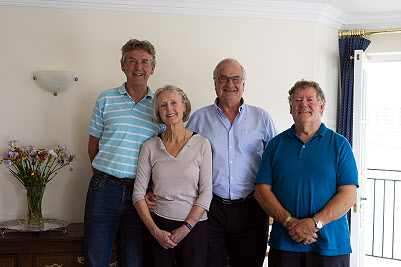
What an honour and privilege !
On Saturday 10th August I travelled to London to meet
three people with a huge connection to the “Royal Charter”
story.
The ship was owned by Gibbs Bright & Company, a partnership
which was
established in the early 1700’s.
In the photograph, left to right are Michael Gibbs, Primrose
Bright and
Charles Bright. The men are the great, great grand sons of the
of the
original owners of the ship.
Charles and Primrose live in Australia and Michael is a UK
resident.
Primrose has researched and put together a comprehensive book
about
the Bright family and their mutual shipping interests.
Michael has published a detailed book on the ‘Family Tree’ of
the Gibbs
together with a history of their merchant activities.
Ian Wilson (son of Ken and Sylvia) joined us and filmed a
lengthy interview
session where all parties contributed.
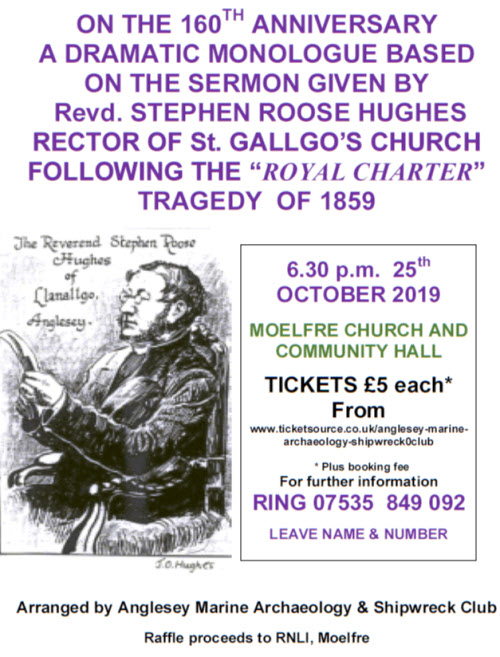
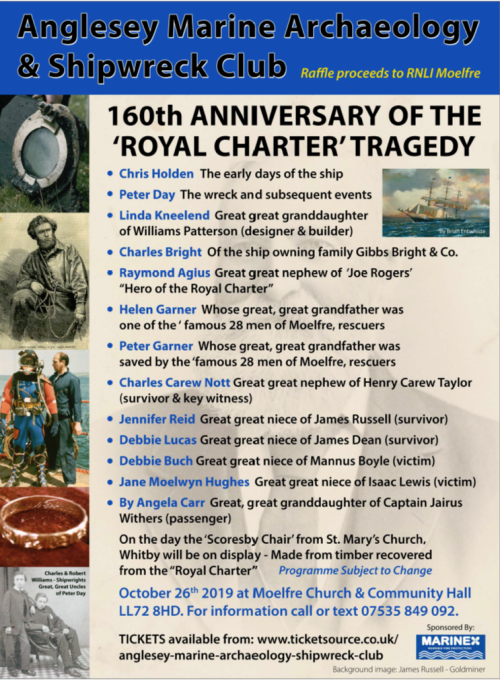
The video will form part of the 160th Anniversary commemorations
to be held
at Moelfre Church & Community Hall on the 26th October 2019.
Peter Day
MOELFRE CHURCH & COMMUNITY HALL
ANNUAL GENERAL MEETING
(Followed by a Meeting of the Church & Community Hall Committee)
7 p.m. Tuesday 26th March 2019
ALL MEMBERS OF THE COMMUNITY ARE ELIGABLE TO ATTEND
Agenda
ELECTORAL ROLL: 2019 Electoral Role awaiting completion
Church Wardens:
Llaneugrad:
Mrs Jeanette Milburn 01248 853073
Llanallgo:
Mr. Dafydd Evans Tel: (01248) 410873
Back to top of page
The Parish of Llanallgo
The churches of Llanallgo and Llaneugrad have been in a single parish since at least 1253 when we were taxed 17s9d to help pay for the crusade then being organised. In March 1320 we had a murder in the church! Three prisoners escaped from Beaumaris Castle and were chased as they made for their homes in the Anglesey wilderness. One of them leuan Cwta was run to earth in Llanallgo Church where he sought sanctuary at St. Gallgo's altar. Sanctuary was not granted and he met his death there. The name of our first recorded parish priest was Peter de Mostyn.
For two periods in the last two centuries there was also a curate in the parish but it would be difficult to imagine what two clerics would have done to have spent their time profitably in the parish. Robert Griffiths was the incumbent in 1623 when he was reprimanded by the bishop for negligence in his duty. 'The sd. parson for not going on perambulation these 2 years'. He had also upset the parishioners because he let his cattle graze in the graveyard and did not clean up after them!
The parish to-day has had two further parishes annexed to it. These are two churches dedicated to St. Michael. One is at Penrhosllugwy and the other at Llanfihangel Tre'r Beirdd. These two churches are associated with Morisiaid Mon. Penrhosllugwy has a burial stone which is dated to 525. It is a very ancient site indeed. It also has some Royal Charter victims' graves. To-day the three parishes have a total civil population of 1500. Of the four churches serving this population Llanallgo is the principal church. We have more ministers in the church now than at any previous time in its history.
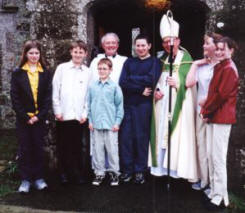 |
On alternating Sundays’ there are 5 & 6 acts of worship. See page one for list of services. The weekly 10 a.m. service is conducted exclusively in Welsh. The parish has an ongoing association with the local Moelfre school. The picture shows former Bishop Saunders Davies, Revd. Canon Dr.. Graham Loveluck (Retired). |
The Present
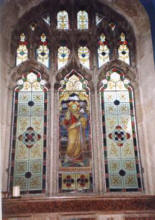 |
Parts of the chancel and the transepts date from the 15th century. Parts of the east window date from the same time. The glass of the east window is Victorian and portrays Jesus walking on the waters of the Sea of Galilee stilling the storm and reminding disciples of His presence. In the south wall of the chancel there is another contemporary window with two cinquefoil lights in a square head window, others are found in the eastern wall and in the south wall of the south transept. In the north transept there is another in the east wall. The roofs are mainly modern but a few trusses may be late medieval. In the chancel there is a wagon roof which is simply decorated. It obscures the point of the east window and the additional trusses which were placed to strengthen the roof. |
A sketch of 1859 shows the wagon roof in the chancel together with a rood screen but there is no sign of the wagon roofs in the transepts. These must have been added later in the restoration during late Victorian times.
At present the church is cruciform in shape – a narrow nave, a shallow chancel and two transepts. Prior to the Victorian renovation and lengthening of the nave the longest part of the church was across the two transepts. A very odd shape! A description of the church in 1859 tells us that there was west chapel attached to the nave and between the nave and the chapel there was circular archway. The chapel was entered through a door on the south side but contemporary prints do not show this doorway. The chapel was known as Capel Ffynnon. It was here that visitors to Ffynnon Gallgo came to give thanks for and to pray for healing at the well which lies midway between the two churches. Perhaps this is the site of Peithian’s oratory. The area is called Bryn Myfyr to this day. The single bell bears the inscription Ave Maria Gracia Plena. It is an ancient bell and a reminder to us of the continuity of worship which exists in this place. What tales it could tell if it could but speak in intelligible tones. [Renovation of the bell]
The Fire of September 1st 2004
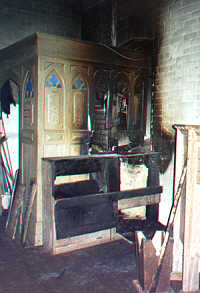 |
On 1st September, 2004, disaster overtook Llanallgo Church. Thanks to an electrical fault caused by rodent activity a fire started at about 1 p.m. Providentially it was discovered by Pat Parry of Marianglas who was leaving for Manchester Airport on holiday. She called in to the church to add her birthday flowers to the altar flowers. Discovering the fire she alerted the emergency services and two fire tenders from Amlwch and Llangefni were on the scene within minutes. By 1.40 p.m. the fire was extinguished. The photograph shows the seat of the fire and the damage caused to the vestry. Smoke damage was considerable. Seven weeks to the day the church was re-opened by Anthony, Bishop of Bangor. |
navigation
- Home
- People & Services
- Renovation of the Bell
- History of St Gallgo's
- Wreck of the Royal Charter
- Rev Stephen Roose Hughes
- Events
- Contact
Moelfre Community
Church Hall
To hire the hall call Peter Day +44 (0) 1248 853444
Royal Charter
For information about the “Royal Charter” shipwreck or families:
Please contact Peter Day
+44 (0) 1248 853444